|
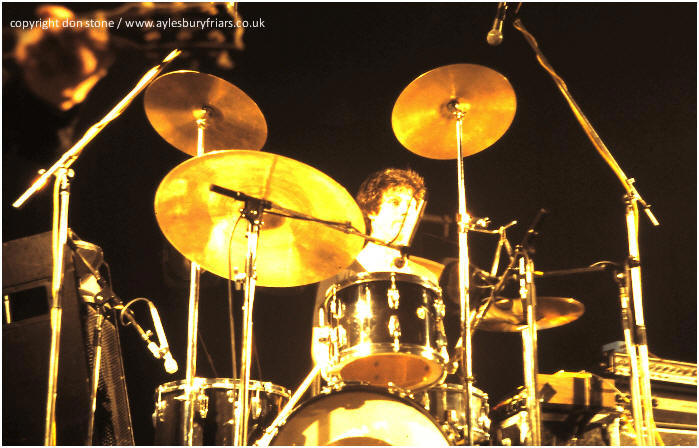
Warren at Friars 14th
October 1978 (Don Stone)
Ultravox
were under John Foxx when they played Friars very critically acclaimed
with three well received albums. It went a bit quiet when John Foxx left
but he was replaced by Midge Ure and the remainder is history as they
say. Ultravox dismantled in the late 1980s but in 2009 the classic line
up reformed for the hugely successful Return to Eden tours.
Drummer and electronic percussion
pioneer tells us here about the Ultravox path to success and their
reformation. We caught up with Warren in June 2011.
Ultravox played Friars in 1978 but the seeds of Ultravox had been sown
before that. What made you decide to come to England in the early
1970s?
My family had emigrated to Canada. I felt my roots very strongly and,
given my musical tastes, it was inevitable and obvious that I’d leave to
move to the U.K. I arrived in London in January 1972. The band’s first
gig was in Chorley, in early April, 1974. It was a warm-up for a gig a
week or so later which we’d scored at the Marquee Club.
Is it true you nearly joined Sparks?
No. I’d seen their advert under ‘Musicians Wanted’ in a music paper.
They weren’t my cup of tea, but; A) as I figured I was one of the few
people in the country who had a clue who they were and B) they were
further up the ladder of achievement than I was (admittedly not
difficult!)… so, I thought I’d go along and see what was up. I didn’t
take to them at all nor – apparently – did they to me. So that worked
out fine!
How did you meet Dennis Leigh (John Foxx) and join Tiger Lily, the
embryonic Ultravox?
Another advert in a music paper, Melody Maker I believe. Before the
internet, the only way to seek out other musicians was the bulletin
board on the wall in music shops or the classifieds section of the music
papers. Plus, of course, hanging out in bars and clubs – a fine and
attractive pastime, though a limited option if you’ve no money.
I’d become very disenchanted trying to find like-minded people. So many
nut cases… I was fed-up, but made one last stab at it and answered an ad
with a very arrogant and over-confident letter. I’d pretty much
forgotten about until I received a call a few weeks later from Dennis.
We met up and hit it off, then I played with the band (still just
Dennis, Chris, and Steve at that point) one afternoon and that was it.
Sometime later, I suggested the name Tiger Lily and was, frankly, very
surprised when Dennis liked it.
When John Foxx left, how did you see the future, if any for the band?
The three albums up that point are seen as classics by many, although
experimental to a degree – did the record company lose faith after the
relatively uncommercial success of these and of course John leaving?
I was pissed off. The music press ignored Chris, Billy and I in favour
of John. We had no record deal and we’d lost our lead guitarist, Robin
Simon, to the attractions of New York. Island Records had never really
known what to make of us and I believe they’d already been set to drop
us, irrespective of John leaving (moot point: he left us / we left
him).
The last album with John, Systems of Romance, was one I was very proud
of. Yet more than that, I knew it was a tantalising harbinger of things
to come and that we were just on the verge of achieving a breakthrough
to… well, I didn’t know to what… but I knew it was going to be great.
The interruption was maddening.
You will have seen the pictures of yourselves playing at Friars in 1978
– good memories (of that time)?
Absolutely. We were playing up and down the country in all manner of
venues. It was a blast. Playing Friars was always an occasion to be
reckoned with.
How did Midge Ure come to join the band?
Bill was playing with Rusty Egan and Midge in what became Visage. Rusty
knew our situation and kept on at Bill saying that he thought Midge was
the perfect candidate to join us. In due course, we met Midge and had a
play and see what happened. It took about ten minutes for us to realise
that it would work.
Was it his individual vision or a collective vision to drive Ultravox
down a new path?
Pardon?! It was a case of Midge being keen to join us and make some
music of consequence, rather than the things he’d previously been doing.
He admired our musicianship and we admired his. It became a collective
vision from the first day.
I remember buying (and still possess) Sleepwalk – a great song and
indicative of a brave new direction – you must have felt that the band
was at last getting some well overdue commercial recognition?
We didn’t quite look at it that way. Rather than feel we were getting
overdue commercial recognition, we were just relieved that we’d finally
gotten something in the charts which would, as a result, enable us to
continue and make more recordings. It’s not called the music business
for nothing.
Hindsight being a glorious thing, you are obviously glad that you
persuaded the record company to release Vienna as a single!
There was no element of hindsight about it whatsoever. We knew the
moment we recorded Vienna that we’d done something special. It was our
feeling that even if everyone else didn’t like it, we had the personal
satisfaction of knowing that we’d creatively hit the nail on the head
and had encapsulated in one distinctive song everything we were trying
to do with that album.
Was the record company lack of faith in such an unusual track the
ultimate reason you ended up financing the Vienna video yourselves?
Their problem was the length of the song wasn’t it?
We wanted it to be the first single from that album. It was obvious (to
us!). We were talked out of it by Chrysalis in favour of the more
conventional Sleepwalk. As we were a newly signed band with no sway, we
agreed under condition that it would be the next release. After the
modest but measureable chart success of Sleepwalk, Chrysalis then
insisted that Passing Strangers be the next single. There was a lot of
argument over this, and we ultimately went along with it on the sole
condition that Vienna would be the third single or else. Passing
Strangers didn’t do as well as they’d hoped and our constant pressure to
release Vienna finally took effect. They somewhat bravely but entirely
half-heartedly put it out…
Their problem was lack of imagination: it bore no relationship to
anything that had ever been in the charts before. Their take was pretty
much, “This won’t get radio play; too long, too slow, too weird.” And
they certainly didn’t want to put any money into a video (we tried).
They magnanimously said, “But you can still do one on your own if you
want.” Which is precisely what we did.
Vienna put us on the map and from that
point on, we had the stature to never again bow to record company
pressure.
We know that the rest is history as they say, but the development of the
band after that was interesting in that going forward you were as far
removed from the ‘old’ Ultravox as possible, or so it seemed to me. Do
you think that’s a fair assessment or do you feel there were still some
definite nods to the past or complete constant evolution albeit with a
commercial bent?
It was a constant evolution and I can easily connect the dots. There was
no sense of making conscious nods to our past because Bill, Chris, and I
were our own past. So, why should we? As for the commerciality of what
we were doing, I can assure you that the very last thing on our minds
was setting out to deliberately write ‘commercial’ music. We always
followed where the song seemed to want to go irrespective of whether or
not that was radio friendly. Our criteria was “Do we like it?”
Naturally, we were concerned about and never shy of commercial success,
but it wasn’t what motivated us. Only after an album was recorded did we
listen with the view, “Will this be successful?”
Live Aid seems to me a pivotal moment in the band’s history both
positively and otherwise. Was the attention Midge was receiving do you
think a mitigating factor in the band starting to crumble a year or so
after?
Yes, I’d say so. In spite of our best efforts over
the years, the band was succumbing to the media’s relentless
predilection to single out the lead singer. The
internal stress this created, plus sundry other issues were definitely
creating fissures. Mostly, I’d have to say we were all pretty burned
out.
Certainly Midge doesn’t hide from the fact that he sees your leaving and
the way it happened as wrong – you must have felt pretty angry at the
time? And quite probably felt it was unjustified.
Sure. I was angry and intensely hurt. After all that we’d been through
together I didn’t think it was the way to solve any problems. I was
beyond disappointed because I felt we still had a lot of great music to
write together. On one odd level, it was probably only that it was my
turn… we all had phases where we’d give each other a hard time.
How have you filled your time in the intervening years? I believe you
have been writing music scores and have been taking some acting roles
and settling in California?
I didn’t do anything much immediately, I was still in shock. I got back
into it by producing demos for people, hoping to get picked up as their
producer when they got a deal. Then I joined a London band called Sons
of Valentino. As much fun as that was, I left them to take up my new
passion – playing rhythm guitar. I’d reached a point where I felt
creatively stifled with drums and, in an epiphany (smiles), decided to
switch instruments. I joined a band led by an old mate of mine, Huw
Lloyd-Langton, to play rhythm guitar and keyboards. It was fantastic and
I learned a lot.
I became sick of the non-scene in London and moved to Los Angeles to
make a new career for myself writing scores and perhaps landing a few
acting jobs. My Helden partner, Hans Zimmer, was becoming extremely
successful so I thought, ”If Hans can do it, how hard can it be?” (wink
wink) What can I say… every bad thing you’ve ever heard about Hollywood?
It’s all true!
While my adventures in La-La Land were undeniably interesting and
occasionally exciting, I finally wore myself out and decided to walk
away from the music and entertainment businesses. Not so much quit while
you’re ahead, as quit while you’re alive.
Do you still have a tinker with technology? I heard you were in Roland’s
bad books for unauthorised modifications to their drum machines! Mind
you if you hadn’t modified the capabilities of those machines at the
time, we may not have had the distinctive patterns of Vienna! It also
must be a lot simpler now!
I’m still into technology of all kinds. My first reaction to a lot of
new stuff isn’t necessarily “Mmm… cool,” it’s “Yeah – about time.” Yes,
I was once on Roland’s persona non grata list for the reasons you
mention. I don’t think I initiated anything in their camp, I’m sure the
stuff I was trying to do to was so obvious and self-evident it would’ve
happened without my input. It just would’ve happened a lot sooner!
It’s simpler now, absolutely. I’ve replaced a six foot high rack of
equipment with a single Mac Book Pro.
You were also effectively pioneering MIDI techniques before they were
actually invented?
Before MIDI, the only way music machines could talk to one another was
through a primitive protocol called CV/Gate (Control Voltage determining
pitch, Gate determining on & off). It was possible to make this stuff
run a synth and talk to a drum machine but it was extremely laborious
and glitch-prone. The mods and controllers I cooked up with the
invaluable assistance of our keyboard techs enabled us to traumatically
force our gear into doing much of what MIDI was later to make a breeze.
It was very exciting but tended to promote brain damage.
I was at the OMD gig at the London Roundhouse in 2008 and after this I
read that the band (or at least most of them) were seen at the gig
fuelling rumours that the band would reunite. How did this come about –
I have to be honest and I was both surprised and delighted this happened
as many never saw this happening for whatever reason. Was it as simple
as someone emailing you all and then you emailing each other as has been
suggested?
More or less, yes. That ‘someone’ was Chris O’Donnell, a former manager
of ours now connected to Live Nation. He e-mailed each of us saying he
thought it might be a good idea for us to now consider getting back
together… The four of us surprised each other when we all replied, “Ok,
let’s try it.” I think Chris’ timing was flawless, mere months earlier
or later and who knows?
The Return to Eden gigs were immense – I saw both legs of the tour and
the first leg, like everyone else, it gave me goosebumps when you started with
Astradyne and the crowd roaring at Billy’s violin section in that song.
Very emotional and we knew you were back. Oh, and not forgetting Mr X of
course!
Thank you. We made a definite decision to not foolishly ‘contemporise’
any of the songs, we felt that they all pretty much held up despite the
passage of time. We were committed to really attack the arrangements and
the playing.
You’ve a new Ultravox album in the pipeline, the first with the classic
line up for 25 years – if you tour that, you will have to remember us in
Aylesbury – we have a big shiny new venue now!
I look forward to seeing it. The new album will have mixed reactions,
there’s no way we can compete with ourselves over material which fans
have assimilated into their lives for all these years. Even back in the
day, it was a common reaction for people to be unsure of each new album
until they’d had time to come to terms with it. But I’m very happy with
what we’re doing and it will be great to play some of it for our
audience.
Warren, thanks for your time and best wishes from everyone at Friars
Aylesbury.
Thank you!
This interview
and its content are © 2011 Mike O'Connor/www.aylesburyfriars.co.uk
and may not be used in whole or in part without permission.
|